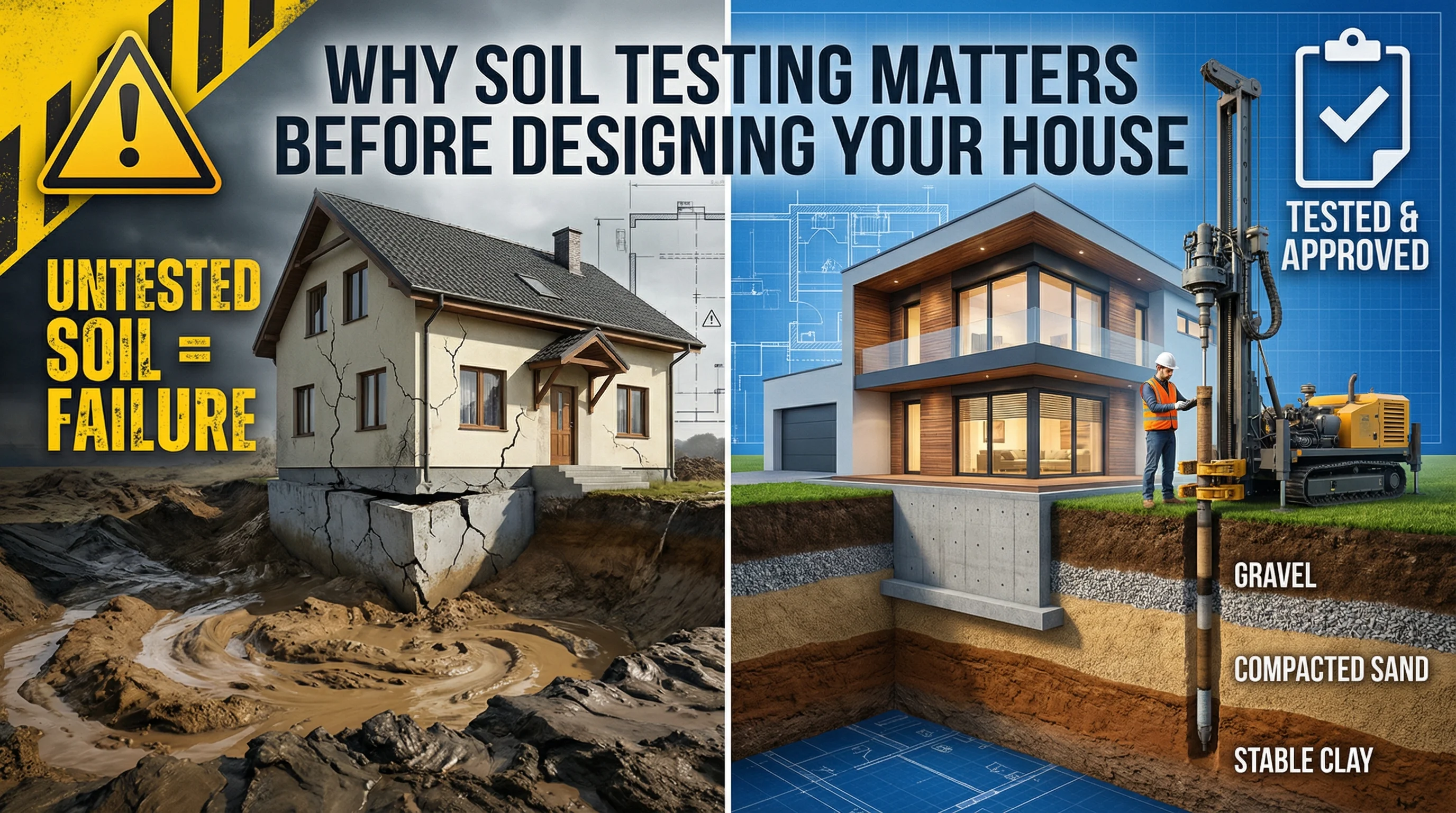
Many homeowners in Pakistan focus heavily on house elevation, layout, and interior finishes but completely ignore soil testing before design and construction. This is a critical mistake. Soil conditions directly influence foundation type, structural design, construction cost, and long-term safety of a building. Without proper soil testing, even a beautifully designed house can develop cracks, settlement issues, or structural failure over time.
Soil testing, also known as geotechnical investigation, involves analyzing the soil beneath a plot to determine its load-bearing capacity, composition, moisture content, and behavior under structural loads. Engineers use this data to design safe and efficient foundations tailored to site-specific conditions.
Soil testing should be done before finalizing architectural and structural drawings because it directly affects:
- Foundation type and depth
- Structural member sizing
- Basement feasibility
- Construction cost estimation
- Long-term building stability
Different soil types require different foundation solutions. Clay, silt, sandy soil, or filled land all behave differently under load. Soil testing helps engineers decide whether strip footings, raft foundations, pile foundations, or isolated footings are required. Designing without this data often leads to overdesign or unsafe assumptions.
Uneven soil strength can cause parts of the building to settle more than others, leading to cracks in walls, slabs, and beams. Soil testing identifies weak zones early, allowing engineers to design foundations that distribute loads evenly and prevent long-term damage.
Many homeowners believe soil testing increases costs, but in reality, it saves money. Without soil data, engineers often design overly conservative foundations to stay safe, increasing concrete and steel quantities unnecessarily. Proper soil testing allows optimized, cost-effective foundation design based on actual ground conditions.
High water tables are common in many areas of Pakistan, especially near canals, rivers, or agricultural land. Soil testing identifies groundwater levels and moisture content, which is crucial for basement planning, waterproofing strategies, and preventing future dampness issues.
Basements and double-storey houses place significant loads on foundations. Soil testing ensures that the ground can safely support these loads or identifies if special reinforcement or foundation systems are needed. Skipping soil testing for such projects is a major structural risk.
- Clayey soil (common in Punjab): prone to expansion and shrinkage
- Sandy soil: good drainage but lower cohesion
- Silt soil: poor load-bearing and erosion-prone
- Filled land: unpredictable behavior, high risk without testing
Soil testing should be conducted immediately after plot possession and before finalizing architectural layouts. Early testing allows architects and structural engineers to coordinate design decisions such as column placement, spans, and floor planning efficiently.
Soil testing must be carried out by qualified geotechnical engineers or certified laboratories. Results should be shared with both the architect and structural engineer to ensure coordinated and safe design decisions.
Experienced architecture firms integrate soil test findings into planning by:
- Adjusting building layout to suit foundation efficiency
- Coordinating with structural engineers for safe load transfer
- Advising homeowners on basement feasibility
- Preventing future structural and maintenance issues
ANU Architects emphasizes soil testing as a foundational step in the design process. By coordinating early with geotechnical and structural experts, the firm ensures that architectural planning aligns with ground realities, resulting in safer, cost-effective, and durable homes suited to Pakistan’s varied soil conditions.
Soil testing is not an optional step or an unnecessary expense — it is a critical investment in your house’s safety, durability, and value. Before designing elevations or approving layouts, homeowners in Pakistan should ensure proper soil testing is conducted. A strong foundation begins below ground, and informed decisions at this stage prevent costly problems in the future.