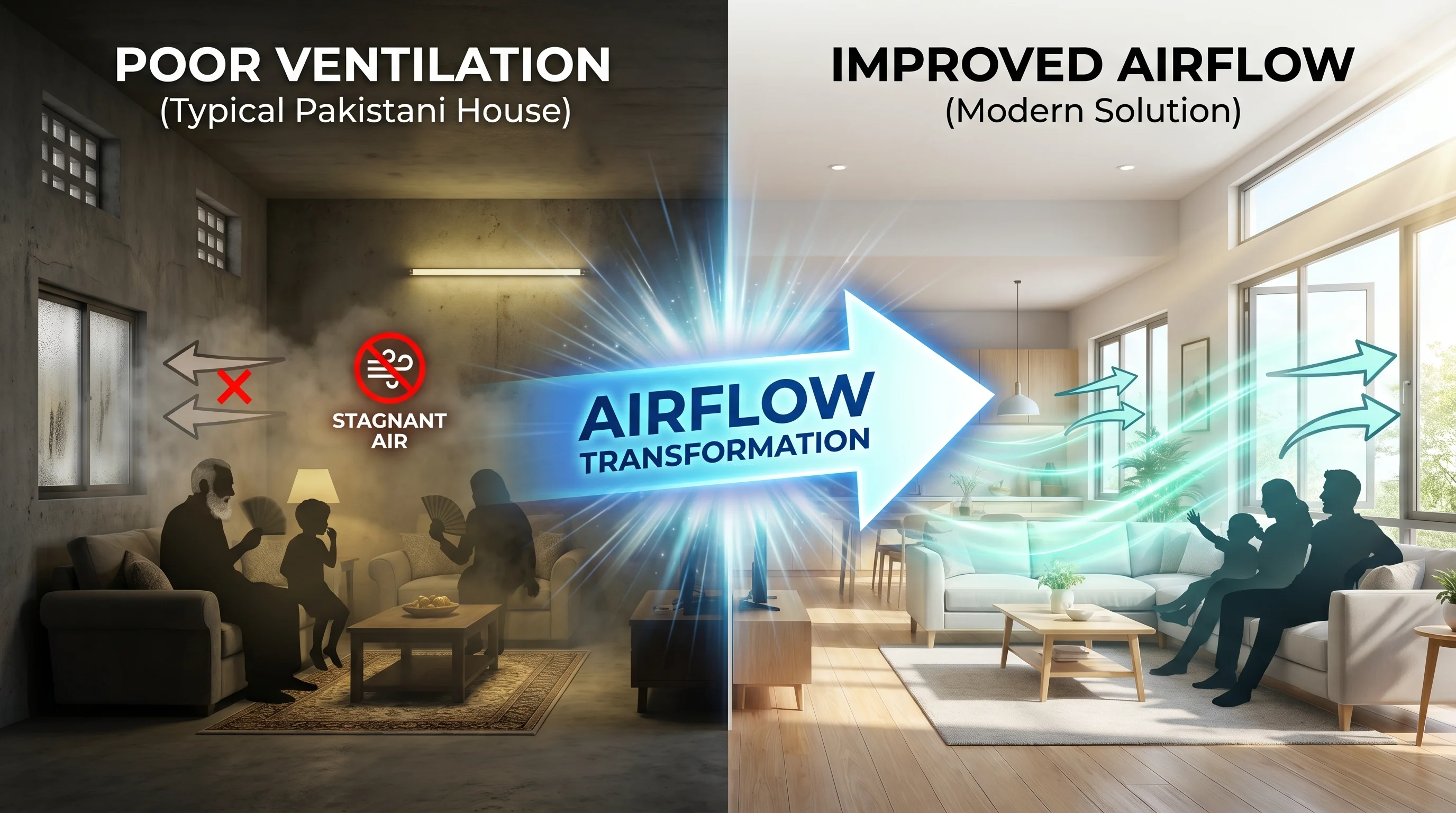
Ventilation is one of the most critical yet overlooked aspects of house design in Pakistan. Many homes suffer from poor airflow, resulting in excessive indoor heat, humidity, and reliance on air conditioning. In cities like Multan, where temperatures can become extreme, improper ventilation significantly reduces comfort and increases energy costs. Understanding why this problem exists and how to fix it is essential for building a healthy and efficient home.
One of the main reasons for poor ventilation is that airflow is not considered during the design phase. Many homeowners rely on contractors or draftsmen who focus only on room placement rather than air movement. Without strategic planning, rooms end up with limited openings and blocked airflow paths.
Cross ventilation occurs when air enters from one side of the house and exits from another, creating natural airflow. Most houses in Pakistan fail to implement this basic principle due to poor window placement or tightly packed layouts.
Common issues include:
- Windows placed on only one wall
- No exit path for air
- Overlapping rooms blocking airflow
To save cost or due to privacy concerns, many homes use small windows or place them in ineffective positions. This reduces both natural light and airflow, making interiors feel congested and dark.
In many housing societies, homeowners try to maximize covered area, leaving minimal open space. This blocks air circulation around the house and eliminates breathing zones such as courtyards, side setbacks, and light wells.
Ignoring sun direction and prevailing wind patterns leads to overheating and stagnant air. Proper orientation allows homes to capture natural breezes and avoid excessive heat gain, especially in hot regions like South Punjab.
Kitchens and bathrooms are major sources of heat, moisture, and odors. Many homes either lack exhaust systems or rely on small ventilators that are insufficient for proper air exchange.
Modern homes often depend entirely on AC systems instead of natural ventilation. While air conditioning provides temporary relief, it increases electricity costs and does not replace fresh air circulation, leading to unhealthy indoor environments.
Ensure every major room has openings on at least two sides where possible. Align windows and doors to allow air to flow through the house naturally.
Use appropriately sized windows placed at effective heights. Combining lower and higher openings can improve airflow by allowing hot air to escape and cooler air to enter.
Internal courtyards or small light wells improve airflow in densely built homes. These elements act as natural ventilation shafts and bring daylight into interior spaces.
Respecting side and rear setbacks ensures that air can circulate around the house. Avoid covering the entire plot, even if bylaws allow higher coverage.
Plan circulation spaces such as corridors and staircases to assist airflow instead of blocking it. Open staircases and double-height spaces can significantly improve air movement.
Kitchens and bathrooms should include exhaust fans or ventilation ducts to remove heat and moisture effectively.
Heat accumulates at the top of the house. Roof ventilators, insulated slabs, and proper ceiling design can help release trapped hot air and improve overall comfort.
A balanced approach using both natural airflow and mechanical systems ensures consistent comfort throughout the year while reducing energy consumption.
ANU Architects prioritizes ventilation from the initial design stage by analyzing plot orientation, wind direction, and spatial layout. Their designs incorporate cross ventilation, optimized window placement, and climate-responsive planning to ensure homes remain cool, comfortable, and energy efficient in Multan’s extreme weather conditions.
Poor ventilation is not a construction issue; it is a design failure. By understanding airflow principles and integrating them into architectural planning, homeowners can significantly improve comfort, reduce energy costs, and create healthier living environments. Investing in proper ventilation design from the beginning ensures long-term value and livability for any home in Pakistan.