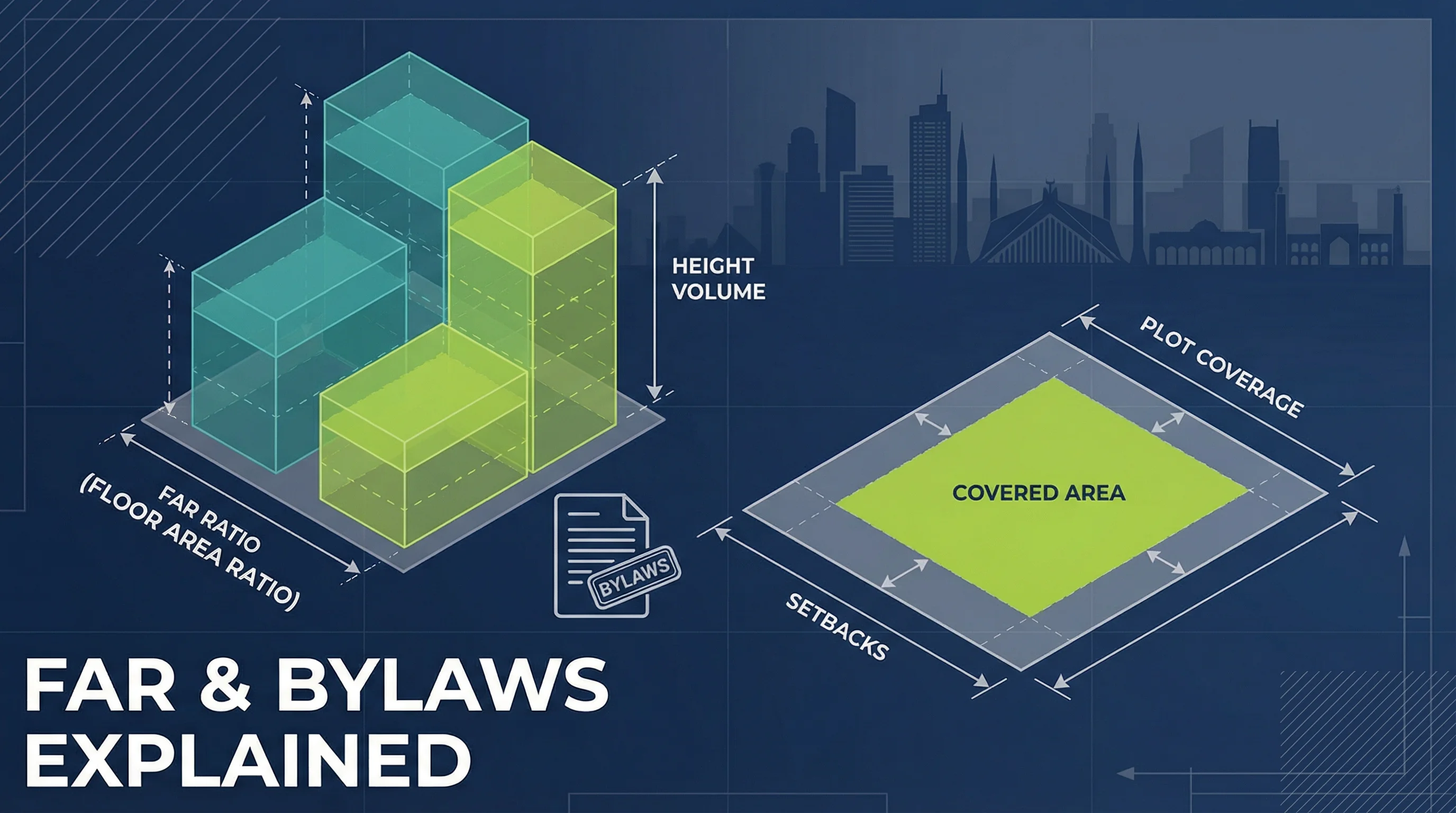
When planning a house in Pakistan, homeowners often encounter technical terms like covered area, FAR (Floor Area Ratio), and building bylaws. These regulations directly affect how much you can build, how high you can build, and what is legally allowed on your plot. Understanding these rules helps avoid fines, demolition orders, and approval delays.
Covered area refers to the total built-up area under the roof or enclosed by walls. It includes rooms, kitchen, staircase, passages, and enclosed spaces. It does not include open terraces, lawns, car porches (if not roofed), and setbacks.
- If you have a 10 Marla plot (250 sq yards), and you build 2200 sq ft on the ground and 2000 sq ft on the first floor, your total covered area is 4200 sq ft.
- Approval authorities set maximum allowable covered area
- Directly influences construction cost
- Impacts ventilation, sunlight, and building safety
FAR or Floor Area Ratio defines how much total covered area can be constructed relative to the plot size. It is used by bylaws authorities to control density, traffic, and infrastructure load in housing areas.
FAR = Total Covered Area / Plot Area
If FAR is 2.0 for a 10 Marla (250 sq yards or approx. 2250 sq ft) plot, you can build:
Total Covered Area = 2250 x 2.0 = 4500 sq ft
- Determines how many floors you can legally build
- Impacts building height and massing
- Controls urban density and infrastructure pressure
Building bylaws are legal rules that govern construction, safety, and urban design across Pakistan. Every authority or housing society has its own set of bylaws to ensure safe, organized development.
- Minimum setbacks from plot boundaries
- Maximum height limits
- Number of allowable floors
- CAR porch dimensions
- Basement rules and ventilation
- Staircase and access requirements
- Parking requirements for commercial plots
- Development Authorities (like MDA, LDA, CDA, DHA, etc.)
- Housing Societies (like DHA, Bahria Town, Wapda Town, Model Town)
- Provincial and Municipal Authorities
Most homeowners misunderstand bylaws, which leads to problems such as:
- Demolition of illegal extensions
- Non-approval from societies
- Heavy fines or penalties
- Poor ventilation due to setback violations
- Reduced resale value due to non-compliance
Homeowners should clarify bylaws before creating a house map because they affect:
- Plot coverage
- Number of floors
- Staircase locations
- Window placement (privacy rules)
- Parking and access
- Basement feasibility
ANU Architects ensures complete compliance with relevant society or authority bylaws by:
- Reviewing governing authority regulations
- Calculating FAR and covered area allowances
- Optimizing sunlight, ventilation, and privacy within setback rules
- Coordinating structural, architectural, and MEP submissions
- Preparing approval-ready drawings for authorities
Understanding covered area, FAR, and bylaws is essential for designing a legally compliant and functional house in Pakistan. These rules are not just paperwork; they shape your home’s design, cost, and long-term value. For smooth approvals and smarter planning, homeowners should work with licensed architectural firms familiar with local regulations to avoid unnecessary delays and penalties.