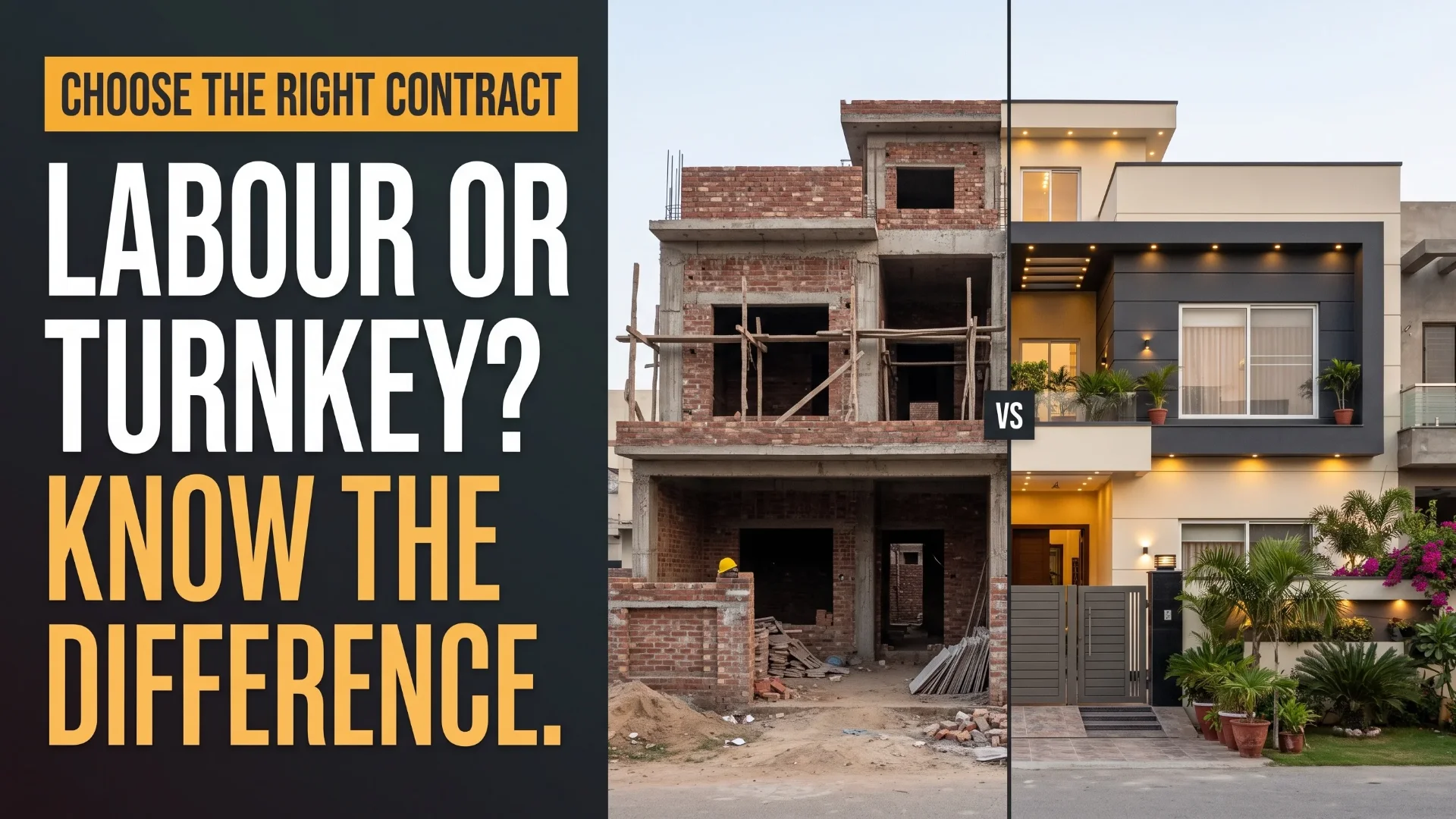
Two contractors can quote very different rates for the same house while offering very different responsibilities. One may provide labour only; another may include materials, coordination and finishing. Comparing the headline rate without reading the scope creates an unreliable budget.
For a Pakistani homeowner, the main distinction is usually who buys materials, manages their delivery and carries the agreed responsibilities for execution. The best choice depends on your time, local support, design information and ability to oversee the work. Neither label guarantees quality or a fixed final cost.

Construction Work in Pakistan.jpg — Zaib Abbasi · CC BY-SA 4.0. Resized and converted to WebP; no cropping.
What does a labour-only contract include?
In a typical labour-only arrangement, the owner purchases materials and the contractor provides specified labour and execution. But the phrase does not define exactly which trades, equipment or temporary works are included.
Ask whether the price covers excavation labour, shuttering, scaffolding, steel fixing, concreting, masonry, plaster, services labour and curing arrangements. Establish who supplies tools, machinery, water and temporary electricity. Some quotations cover only the grey structure; others extend further.
The attraction is greater control over purchasing. The practical obligation is managing that purchasing well enough to keep the site supplied without excessive stock, damage or repeated emergency orders.
What does turnkey construction include?
A turnkey arrangement generally aims to deliver an agreed completed house with the contractor coordinating the specified labour and materials. Its usefulness depends on how clearly “completed” is defined.
A description such as “A-grade finish” leaves too much open. Specify the relevant product, performance, size, finish or allowance for items such as tiles, sanitary fittings, doors, windows and hardware.
Confirm whether approvals, utility connections, external works, wardrobes, kitchens, appliances, solar equipment and landscaping are included. A finished-looking interior may still leave substantial work outside the agreed package.
Compare responsibilities side by side
The following table describes common arrangements. Your signed agreement may allocate duties differently.
| Responsibility | Labour-only arrangement | Turnkey arrangement |
|---|---|---|
| Material purchasing | Usually owner | Usually contractor within agreed specification |
| Delivery scheduling | Owner coordinates with site team | Usually contractor |
| Material selection | Owner, supported by designer | Owner approves specified selections or allowances |
| Day-to-day owner involvement | Usually greater | May be lower, depending on contract and reporting |
| Substitution control | Check delivered owner purchases | Check proposed and delivered contractor purchases |
| Changes and extra work | Require documented pricing and approval | Require documented pricing and approval |
| Quality verification | Still needs defined inspections | Still needs defined inspections |
Insurance, safety, material custody and loss responsibilities should be expressly allocated. Do not infer them from the contract's title.
Compare the same house and the same scope
Prepare one set of drawings and specifications for bidders. Give them a consistent schedule of inclusions, exclusions and allowances. Ask each to state the area-measurement method and the treatment of stairs, roof structures, covered terraces and external works.
Then compare the expected total commitment. For labour-only work, add the owner-supplied materials, transport, unloading, storage, testing, professional services and other excluded costs. For turnkey work, add the items outside the package and identify provisional allowances.
ANU's existing Multan construction-cost article introduces the separation between structure and finishing. A procurement comparison should use your actual drawings and current quotations rather than a generic house-size label.
Choose according to owner capability
A labour-only arrangement may suit an owner who can organize purchasing, maintain records and respond promptly to site needs. That owner still benefits from professional checks and a contractor with a clear execution scope.
A turnkey arrangement may suit an owner who prefers a more consolidated delivery responsibility, particularly when living elsewhere. The owner should still approve the design, review substitutions and obtain the agreed inspections.
Ask yourself three practical questions: Who can make purchasing decisions during working hours? Who will verify delivery and quality? Who will review the cost and time effect of a change? If nobody has a clear answer, resolve the project organization before choosing a contract.
Put payment and changes into a written process
Define how progress is measured, what documents support each payment and who checks the work. Agree how advances, material payments, outstanding defects and final completion are treated. Payment percentages should follow the negotiated scope and cash flow rather than an unexplained standard split.
For every proposed variation, record the description, reason, price and effect on completion. Keep the approval with the relevant drawing revision. A verbal request for a different staircase or tile can affect more trades than the owner expects.
The Pakistan Engineering Council's civil-works documents demonstrate the role of coordinated conditions, specifications and contract documents. That large-project form is background reading, not a private-house agreement to copy without professional adaptation.
Frequently asked questions
Is labour-only construction always cheaper?
No. Compare the total owner cost, including purchasing, logistics, coordination and excluded work. A lower labour quotation does not establish a lower completed-house cost.
Does turnkey mean I never need to visit the site?
No. Visits, reporting and inspections should match the agreed project responsibilities. Where you cannot attend, arrange appropriate local representation and technical verification.
Can the contractor increase the agreed rate?
That depends on the agreement, including scope changes, adjustment provisions and other relevant terms. Ask a qualified adviser to review the actual contract instead of relying on the word “fixed.”
Make the responsibilities as clear as the price
A good arrangement tells everyone what they must deliver, what evidence confirms progress and how a change is handled. Once those points are clear, the price comparison becomes more useful.
Contact ANU Architects to discuss design documentation and the professional scope needed before you invite construction quotations.